


Nature - 2019 January - Vol 565 No 7741
Publisher: Nature
Format: Paperback
ISBN: 9770028083095
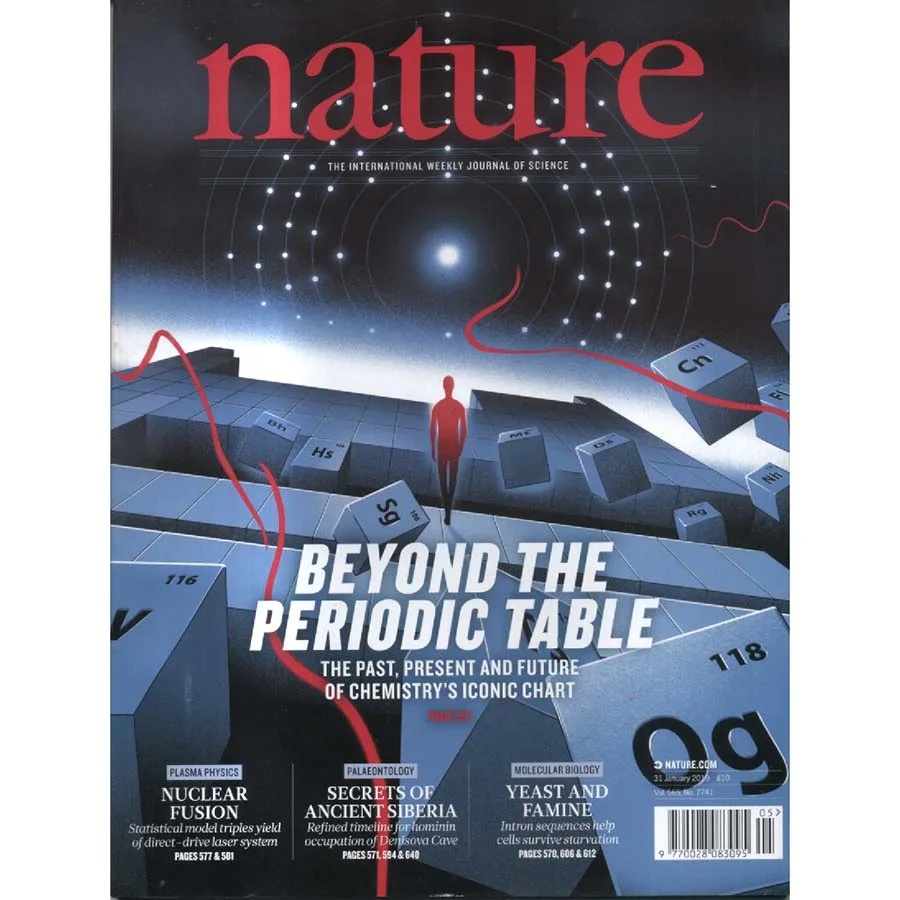
There are magazines that ease gently into a new year with recipes, mindfulness, or perhaps optimistic fitness advice. Nature – January 2019, Vol. 565 No. 7741 instead opens the year by marching boldly “BEYOND THE PERIODIC TABLE”, casually suggesting that even chemistry’s most sacred classroom poster may merely be a temporary administrative arrangement.
The cover artwork is glorious in that unmistakably Nature style: part retro-futurist science fiction, part philosophical crisis. Giant elemental blocks float through space while a lone red figure wanders across the periodic table like an explorer who has accidentally stepped into a postgraduate thesis. Somewhere beyond element 118 lies either the future of chemistry or a very expensive laboratory accident.
The main feature examines the past, present, and future of the periodic table — humanity’s iconic attempt to impose order on matter itself. Naturally, scientists have reached the point where they are now calmly discussing what comes after it. Most people struggle to remember the symbol for magnesium, while somewhere in this issue researchers are contemplating superheavy elements and the boundaries of atomic existence.
And because this is Nature, the issue immediately broadens into several entirely different frontiers of human understanding. Nuclear fusion appears, once again, as the scientific equivalent of “this time we really mean it”. Palaeontologists revisit Denisovan Cave to uncover ancient hominin secrets, while molecular biologists study how cells survive starvation. Every article feels like another reminder that humanity has decided absolutely nothing in the universe is allowed to remain mysterious.
The Denisovan feature is particularly wonderful because it captures the modern scientific habit of repeatedly discovering ancient humans nobody knew existed ten minutes ago. By 2019 the human family tree was already beginning to resemble a deeply confusing group project spanning multiple continents and species.
Meanwhile, nuclear fusion continues its decades-long tradition of sounding simultaneously imminent and perpetually thirty years away. Every generation inherits fresh optimism that limitless clean energy is just around the corner, usually accompanied by diagrams glowing in suspicious shades of blue.
One of the enduring joys of Nature is its complete refusal to simplify its ambitions. This is not a magazine that says, “Here are some interesting facts.” This is a publication that quietly documents humanity attempting to decode the universe at every scale, from starving cells to superheavy elements. And it does so with the calm confidence of someone alphabetising paperwork.
Naturally, owning a copy of Nature projects a certain intellectual atmosphere. It implies curiosity, seriousness, perhaps even the occasional informed opinion about transuranic elements. Whether you actually read the detailed chemistry discussions or simply admired the magnificent cover while feeling slightly overwhelmed is entirely secondary. The magazine works equally well as advanced scientific literature and aspirational furniture.
This January 2019 issue now feels like an ideal opening chapter for the strange scientific decade that followed. Gene editing, fusion, ancient DNA, advanced materials — the future was arriving rapidly, often in highly technical language accompanied by dramatic illustrations.
Condition is listed as Good, meaning this copy has survived the standard hazards faced by elite scientific journals: overloaded backpacks, desks buried beneath unread ambitions, caffeine incidents narrowly avoided, and years spent waiting patiently for someone to finally tackle the article on direct-drive laser systems.
A superb issue for science enthusiasts, chemistry lovers, futurists, or anyone who enjoys magazines that casually suggest the periodic table itself might only be the beginning.
Keep browsing: See more Nature Journal books Other books by Nature
